
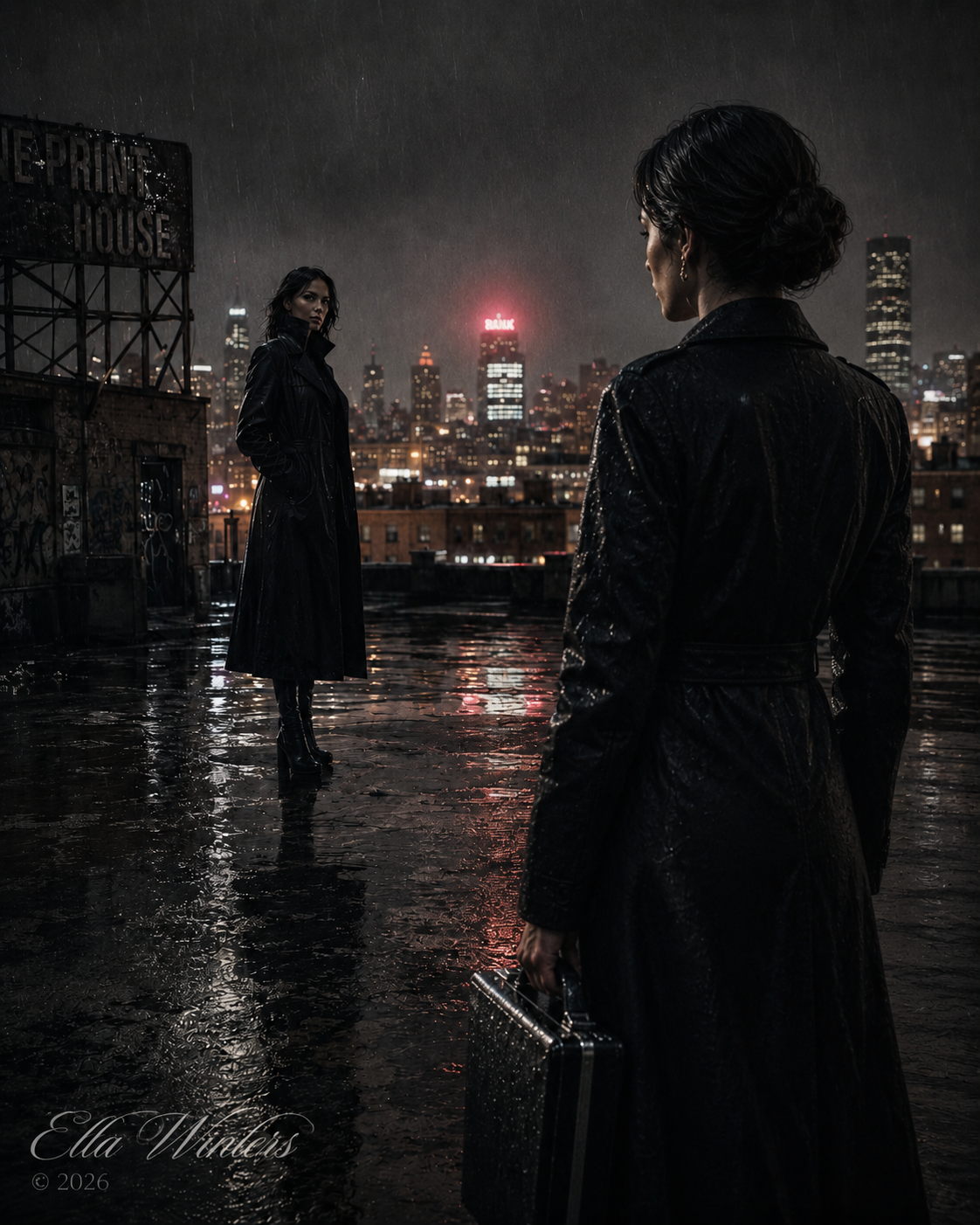
I. The Print House
The rain fell in thin, silver needles.
Not heavy enough to drown the city.
Just sharp enough to find every seam.
Ella stood on the rooftop of the abandoned print house with her coat collar turned up and her hands resting loose at her sides. The city bled beneath her in streaks of red, white, and amber, all of it smeared across the wet concrete like faulty surveillance footage.
Above her, the old sign still read:
PRINT HOUSE
Half the letters were dead.
Ella liked that.
Places always kept their names long after they stopped being true. People did the same. Governments made entire departments out of it.
The dead, at least, were honest.
Rainwater collected near the south parapet, gathering in shallow pools that turned the rooftop into a broken mirror. Every light below fractured inside them. Every passing car became a brief pulse of color before the water swallowed it again.
The city kept moving.
It always did.
That was the lie cities told best, that motion meant life. That traffic meant purpose. That lit windows meant someone inside them understood what was happening.
Ella knew better.
Most lights were just witnesses afraid to blink.
She waited near the edge of the roof, still enough to belong there. The rain traced her coat, her jaw, the backs of her hands. It did not soften her. It only made her sharper.
The target was late.
Ella did not check the time.
Time belonged to people who still believed they could spend it.
Waiting was part of the current.
Most people fought waiting. They checked their watches, shifted their weight, filled the silence with breathing, muttering, movement, noise. They treated stillness like a locked room and panicked when it did not open.
Ella simply stood inside it.
There was power in not needing the moment to end.
There was power in letting the other person arrive already behind.
Below, a siren moved through the streets and faded. Somewhere, a transformer hummed behind a chain-link fence. Somewhere else, a camera turned in its housing, searching the dark with the confidence of a machine that had never learned fear.
Ella did not move. The rain moved around her the way people moved around power lines. Instinctively. Without thinking.
As if some old part of the world already knew what she was.
As if the rooftop knew.
As if the dead sign above her knew.
As if the city, for all its noise and glass and electrical arrogance, understood one simple truth:
The current had arrived before the target ever did.
II. Lethal Current
Ella Winters had been removed from seventeen databases.
Her name had been burned out of three classified registries, erased from two funeral records, and misspelled on one marble wall in Virginia.
No correction had ever been filed for the marble. That amused her. The living loved precision until precision became inconvenient.
In the files, Ella had been called several things. Asset. Liability. Compromise risk. Ghost. Unresolved operational anomaly.
None of them mattered. Only one title had survived the erasures.
Lethal Current.
It had started as a joke inside a unit that no longer officially existed. Some junior analyst with too much caffeine and not enough fear had written it in the margin of a threat assessment after Ella survived an operation no one was supposed to survive: “Asset behaves less like a human operator and more like electrical weather.”
The phrase circulated. Then the bodies did.
After that, nobody laughed when they said it.
III. Helena Voss
The first camera picked up Helena Voss at 11:47 p.m.
Ella saw the reflection before she saw the woman.
A gray coat moved through the alley below. A pale hand gripped a rusted fire escape. A briefcase swung at Helena’s side like a mistake with a handle.
Helena looked up once. Not at the rooftop. At the neighboring building’s fifth-floor window.
Old habit. Old tradecraft. Old guilt.
Ella watched from the roof as Helena climbed. Slowly. Carefully. Like the building itself might judge her and drop her back into the alley. By the time Helena reached the top, her expensive hair was wet, her collar was soaked, and fear had begun to bend her inward.
That was what fear did. It revealed posture.
The rooftop door groaned open. Helena stepped out into the rain.
For a moment, neither woman moved. The city held its breath. That was generous of it, considering how rarely cities showed manners.
Helena saw Ella near the parapet and stopped cold.
The briefcase shifted in her hand. Her mouth opened. Closed. Opened again.
“You’re supposed to be dead,” Helena said. Her voice cracked on the last word.
Ella did not answer right away. The current did not rush. It simply arrived.
Helena took one step forward. Her heel clicked against the wet concrete, slipped slightly, then recovered. Not fast enough to hide the panic.
“You were confirmed dead,” Helena said.
Ella tilted her head. “Sounds to me like you need better sources to be confirming things.” Water traced the line of her jaw and disappeared beneath her coat collar.
IV. The Archive
Helena swallowed.
There were a dozen answers available to her. All of them were useless.
That was the trouble with people who spent their lives inside rooms where language was power. They reached for words even after the room had burned down.
“I didn’t know they would do it,” Helena said.
Ella watched her without blinking.
The rain filled the silence between them. Helena tried again. “I knew what the program was. I knew what they wanted. But I didn’t know they were going to clean the field.”
“Clean,” Ella said. The word landed flat. Ella laughed.
Helena flinched.
Good. Some words deserved to hurt on the way back to their owner.
“They called it consolidation,” Helena said quickly. “A restructuring of assets after exposure risk. I thought they were pulling people out. I thought they were burning covers, not houses.” The wind pushed the rain sideways across the rooftop.
Somewhere below, a siren passed through the city and faded into distance.
Ella looked past Helena toward the door. “Did you think that when the safehouse in Newark went quiet?”
Helena’s face changed. Not much. But enough.
“Or Istanbul?” Ella asked. “Or the apartment in Prague where they found the kettle still warm?”
Helena looked down. The briefcase trembled once in her hand. “I had no operational control,” Helena said.
“No,” Ella said. “You only moved the names.”
The sentence cut through the rain cleaner than any blade.
Helena closed her eyes.
There it was.
Not confession. Recognition.
Confession was theater. Recognition was evidence.
Ella had learned the difference after the second funeral. At the first, Ella had still believed grief required ceremony. At the second, Ella realized ceremony was what institutions used to make murder look organized. At the third, Ella stopped attending them. After that, the funerals became administrative events.
Reports moved.
Flags folded.
Signatures collected.
A widow touched a wooden box and thanked a stranger for coming. The stranger wore a suit and knew nothing.
The box was empty. The file was complete.
The machine moved on.
V. No Negotiation
Helena opened her eyes.
“I brought the archive,” she said.
She lifted the briefcase slightly, as if presenting an offering to some old god with poor customer service.
The gesture was ridiculous.
Human.
Almost sad.
“Everything is in here,” Helena said. “The burn list. The private buyers. The shell accounts. The committee members who authorized the transfers. Names. Dates. Payment routes.”
Ella did not look at the briefcase.
That frightened Helena more than interest would have.
“You wanted proof,” Helena said.
“I wanted truth,” Ella answered.
Helena’s lips parted. The distinction was too clean for her. “Then take it,” Helena said. “Take the archive and let me disappear.”
The rain hissed across the rooftop.
Ella finally moved. One step. Only one.
Helena stiffened as if Ella had crossed half a continent.
“You already disappeared,” Ella said. “That was the problem.”
Helena’s face tightened.
“I was trying to survive.”
“So were they.”
That ended the sentence Helena had been preparing. Most sentences deserved worse.
For one moment, there was only rain, skyline, breath, and the old print house sign groaning softly in the wind.
Inside that moment, Helena seemed smaller. Not harmless. Never harmless. Small.
There was a difference.
Small people could still ruin nations if given the right office, the right clearance, the right fear, and enough polished language to make cowardice sound like strategy.
Helena shifted her weight.
Her right hand moved toward her coat. Slowly. Almost courteously. She already knew how this ended. Ella watched the movement with the tired patience of a storm watching a matchstick.
“Don’t,” Ella said.
Helena froze.
The rooftop lights flickered. Somewhere below them, a transformer gave off a low electrical hum.
“I have money,” Helena said.
Ella said nothing.
“Information,” Helena tried. “Access. Routes out. Names no one else knows.”
Rain ran down Helena’s face now, breaking the makeup along one cheek.
“Whatever you want,” Helena said. “We can negotiate.”
Ella tilted her head. Water traced the line of her jaw again, bright for one second in the city glow. “The current does not negotiate with the living.”
Helena’s hand twitched. The sound that followed was small.
Not dramatic. Not cinematic.
Just a brief mechanical punctuation beneath the rain.
Helena stumbled once.
The briefcase hit the rooftop first.
Then Helena followed.
The body made a dull sound the rain immediately began to erase. Ella did not look down. There was nothing to see that the current had not already carried away.
VI. The Briefcase
Ella crossed the roof and picked up the briefcase.
It was heavier than it looked.
They usually were.
Inside, Ella found three drives, two paper ledgers, a folded photograph, and a black phone wrapped in a clean handkerchief.
The photograph stopped her for half a second. Not because it surprised her. Because it did not.
Fourteen people stood outside a building in winter light, smiling badly for whoever had taken the picture.
Half of them were dead. Three were missing. Two were living under names so thin they could barely hold a life. Ella stood in the back row.
Younger. Unburned. Not smiling.
She placed the photograph back in the briefcase.
Sentiment was not weakness.
But timing mattered.
Behind her, Helena’s phone began to vibrate. Once. Twice. Then again. Ella looked at the screen: “UNKNOWN CALLER.”
That amused her most of all. The world was ending in layers, and some fool still believed anonymity was a feature.
Ella answered.
No voice spoke at first. Only static. Then a man said, “Is it done?”
Ella looked out over the city. The rain blurred the skyline until Denver looked less like a place and more like a memory being dragged underwater.
“She brought the archive,” Ella said.
Silence followed.
Then the man said, “That was not the objective.”
“It is now.”
He breathed once. Carefully. “You have become difficult to manage.”
Ella looked down at the briefcase.
“No,” Ella said. “You have become easy to read.”
The line went dead.
Ella slipped the phone into the briefcase and closed it. Across the roof, the old print house sign groaned again. A gust of wind pushed rain beneath her collar. For a moment, Ella allowed herself to feel the cold.
Not as discomfort. As confirmation.
The body was still present. The machine had failed to erase that much.
VII. Mara Vale
Ella walked to the rooftop door and descended the stairs without hurry.
Inside, the print house smelled of wet brick, old ink, rust, and dead paper. Machines sat under tarps on the production floor below, huge and silent, their metal teeth waiting for work that would never come.
A place built to spread information had become a tomb for it.
Humans did enjoy irony, provided it happened to someone else.
On the third-floor landing, Ella stopped.
A shadow stood at the end of the hall.
Female.
Still.
Unarmed, or pretending to be.
The woman stepped into the weak light leaking from the stairwell window.
She wore a dark coat. Her hair was pinned back. Rain shone on her shoulders.
She was older than Helena.
Calmer than Helena.
Far more dangerous because she had survived long enough to stop needing theatrics.
“Mara,” Ella said.
Mara Vale gave the smallest nod.
“Ella.”
The name sat between them like a forbidden object.
Neither woman touched it.
Mara’s eyes dropped to the briefcase.
“So she came.”
“She was late.”
“She always needed an audience.”
“She found one.”
Mara almost smiled.
Almost.
That was the problem with old friends in dead professions.
Every expression had a body count behind it.
“She gave you the archive?” Mara asked.
“She tried to buy mercy with it.”
“And?”
Ella moved past her.
“The exchange rate was unfavorable.”
Mara followed Ella down the stairs.
Their footsteps echoed through the hollow building.
“You know what happens now,” Mara said.
“Yes.”
“They’ll send the committee into quarantine. Burn the accounts. Kill the couriers. Blame Helena for the whole chain.”
“They can try.”
Mara glanced at her.
“That sounded almost hopeful.”
“Don’t insult me.”
This time Mara did smile.
It looked like grief pretending to be expensive.
VIII. The Transmission
They reached the ground floor.
The old presses loomed around them in rows, black hulks beneath plastic sheeting. Rainwater dripped steadily from somewhere in the ceiling, tapping into a metal pan with the precision of a countdown.
Mara stopped beside one of the presses.
“There are still people in that archive,” Mara said. “People who think they’re safe because nobody remembers them.”
Ella looked at her.
“Nobody remembers the dead until they become inconvenient.”
“That’s not an answer.”
“It is the only answer the living earned.”
Mara held her gaze.
For a second, they were back somewhere else.
Not this city.
Not this life.
A room with too much fluorescent light.
A mission board.
Bad coffee.
Someone laughing at the wrong time.
The soft, brutal arrogance of people young enough to think survival was mostly skill.
Then the memory passed.
They always did, if you didn’t feed them.
Outside, a black car waited at the curb with no lights on.
The driver sat motionless behind the wheel.
Mara reached for the passenger door, then stopped.
“Where are you taking it?”
Ella looked down at the briefcase.
“To the only place they cannot bury it.”
Mara narrowed her eyes.
“That sounds dangerous.”
“It is.”
“Illegal.”
“Likely.”
“Catastrophic.”
Ella opened the rear door.
“Now you’re flirting.”
Mara looked away first.
That answered a question neither of them had been foolish enough to ask.
IX. Electrical Weather
Inside the car, the air was warm and smelled faintly of leather, rain, and old cigarettes.
Ella slid into the back seat with the briefcase beside her.
Mara got in after her.
The driver pulled away from the curb without being told.
He knew better.
The city moved around them in streaks of amber and red. Buildings passed like witnesses refusing deposition.
Underpasses swallowed the car.
Then released it into light again.
Ella opened the briefcase on her lap.
The first ledger was handwritten.
That made her pause.
Nobody wrote by hand unless they were sentimental, paranoid, or old enough to know servers could be bribed.
The dates went back nine years.
The first entries were clean.
Asset names.
Transfer approvals.
Payment chains.
Internal designations.
Then the language changed.
Recovery became denial.
Denial became sanitization.
Sanitization became erasure.
Erasure became mercy.
There it was.
The moral collapse of an institution, documented in neat blue ink.
Mara read over Ella’s shoulder.
“God.”
“No,” Ella said. “Just people with budgets.”
Mara said nothing after that.
The car turned onto an industrial road near the river, where warehouses sat dark and long beneath the rain.
A freight train moved somewhere in the distance, its horn low and mournful.
Ella removed one drive from the case and handed it to Mara.
“You know where to send it.”
Mara stared at the drive.
“This will detonate half the network.”
“Only half?”
“The other half will come for you.”
“They already did.”
Mara’s hand closed around the drive.
“Eighteen times,” Mara said softly.
Ella looked out the window.
“That number was always flattering.”
Mara’s voice lowered.
“Were they all false?”
The rain tapped against the glass.
For a long time, Ella did not answer.
Then she said, “No.”
The car continued through the city.
That was the closest thing to confession the night would receive.
X. The Current Keeps Moving
Later, when the first transmission began, it did not come through official channels.
It appeared across a dozen dead servers.
Then three private networks.
Then a public drop hidden beneath corrupted financial disclosures.
It arrived without signature.
Without claim.
Without manifesto.
Just files.
Names.
Dates.
Orders.
Accounts.
Photographs.
Empty boxes.
Enough truth to ruin everyone who had survived by misfiling the dead.
By 2:13 a.m., two committee members had gone dark.
By 2:27, a private aircraft requested emergency departure clearance and was denied for weather.
By 2:41, a deputy director in a secure residence looked at his phone, went pale, and asked his wife where the passports were.
By 3:08, the first news editor received the archive and mistook it for a hoax.
By 3:09, she opened the second folder.
After that, she stopped laughing.
In the back of the black car, moving through the city like just another shadow, Ella allowed herself one small indulgence.
The low amber glow of a cigarette.
The faint burn.
The brief reminder that the body was still temporary and therefore worth using carefully.
Mara watched the smoke curl toward the roof.
“I thought you quit.”
“I did.”
“When?”
“Every time.”
Mara looked out the window and smiled despite herself.
The driver did not speak.
Again, he knew better.
The car crossed the river.
Behind them, the old print house disappeared into the rain, its broken sign still standing over the roof like a witness with nothing left to lose.
Ella looked at the city.
Somewhere inside all those lit windows, people were sleeping beside phones that would soon begin screaming.
Some would run.
Some would lie.
Some would tell themselves they had only followed procedure, which was the oldest lullaby evil ever learned.
The archive moved outward.
The network began to fracture.
And somewhere in the distance, another transmission was already beginning.
Mara turned toward Ella.
“What happens after this?”
Ella exhaled smoke into the dark.
The answer was not comfort.
It was not threat.
It was simply weather.
“The current keeps moving.”
The city lights slid across the rain-streaked glass.
“It always does.”